

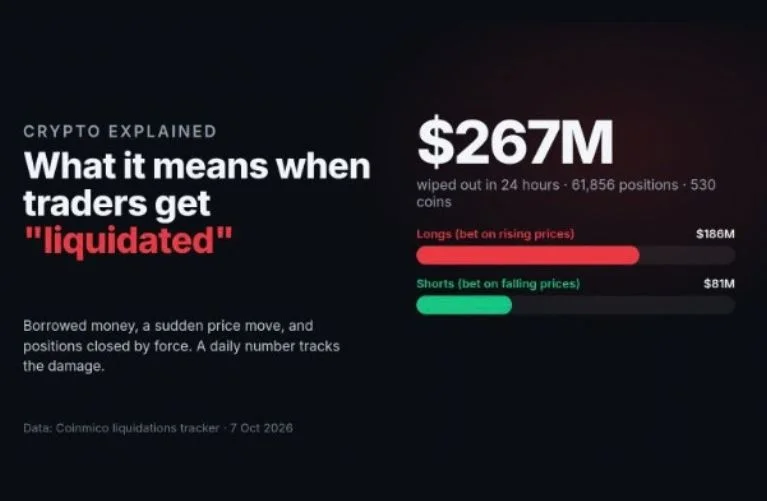
Scroll through crypto news on any rough day and one word keeps appearing: liquidated. “$300 million liquidated in an hour.” “Traders liquidated as Bitcoin slips.” It sounds violent, and for the people involved it is. But I realised recently that I did not actually know what it meant, so I asked around and read up. Here is the plain-English version, from how a liquidation works to why it moves the whole market and what you can do to avoid one.
What Does “Liquidated” Mean In Crypto?
In crypto, a liquidation is the forced closure of a trade that was funded with borrowed money. When the price moves far enough against the trader, the exchange or lending platform closes the position automatically, sells what is needed to repay the loan and keeps most or all of the trader’s deposit. The trader has no say in the timing. It is the crypto equivalent of a bank repossessing a car when the payments stop, except it happens in seconds and without warning.
Liquidation only applies to leveraged or borrowed positions. If you simply buy Bitcoin with your own money and hold it, nobody can force you to sell.
Trading With Borrowed Money
Most liquidations happen on something called perpetual futures, which are the crypto world’s most popular trading product. The idea is simple: instead of buying a coin outright, you put down a deposit and borrow the rest from the exchange, so a $1,000 deposit can control a $10,000 position. That is “10x leverage”. If the coin rises 5 per cent, your position gains $500, a 50 per cent return on your deposit. If it falls 5 per cent, you lose $500, half your money.
Because the exchange has lent you the other $9,000, it will not let the loss eat into its share. At a pre-set price, it closes your position automatically and keeps your deposit. That forced closure is a liquidation. You do not get a phone call. The trade simply disappears, along with your money.
Unlike traditional futures, perpetual contracts have no expiry date, so a trader can hold a position for as long as their deposit survives. To keep the contract price close to the real coin price, longs and shorts pay each other a small “funding rate” every few hours. Those payments also come out of the deposit, which is one more way a position can drift towards liquidation over time.
How The Liquidation Price Is Worked Out
Every leveraged trade comes with a liquidation price, shown on the exchange screen the moment the position opens. It depends on three things:
- Initial margin: the deposit you put down. At 10x leverage it is 10 per cent of the position; at 50x it is just 2 per cent.
- Maintenance margin: the minimum cushion the exchange insists you keep, usually somewhere between 0.5 and 1 per cent of the position for major coins and higher for smaller ones.
- Fees and funding: trading fees and funding payments slowly reduce the cushion.
As a rough rule, a position is liquidated when the loss eats through the initial margin down to the maintenance level. At 10x leverage that means a fall of a little under 10 per cent. At 25x it is about 3.5 per cent, and at 100x it is under 1 per cent, a move Bitcoin can make in a few minutes on a quiet afternoon. Higher leverage does not just raise the reward; it moves the liquidation price uncomfortably close to the entry price.
Isolated Margin And Cross Margin
Exchanges usually offer two ways of holding a leveraged position. With isolated margin, only the deposit attached to that one trade is at risk; if it is liquidated, the rest of your account is untouched. With cross margin, the whole account balance backs every open position. That can keep a trade alive for longer, but if the market keeps moving, one bad trade can drain the entire account. Beginners are generally safer with isolated margin, because the maximum loss is known before the trade starts.
Why The Numbers Are So Large
A single trader losing $1,000 is unremarkable. The headlines come from adding them all up. On the day I checked, roughly $267 million of positions were liquidated across the major exchanges in 24 hours, according to Coinmico, an independent market data site that tracks the figure. That was spread over about 62,000 separate positions on 530 different coins, and it was more than three times the previous day’s total. On the worst days in crypto history, the figure has passed several billion dollars. In October 2025, one sharp sell-off wiped out more than $19 billion of leveraged positions in roughly a day, the largest liquidation event on record.
The split matters too. About $186 million of that day’s total were “longs”, traders betting on prices going up, against $81 million of “shorts”, betting on them going down. When longs dominate the liquidations, the market has just fallen sharply and caught optimists off guard. When shorts dominate, it has just surged and the pessimists have been squeezed. Reading that split tells you more about what just happened than the price chart does.
Why Liquidations Make Moves Worse
Here is the part that makes liquidation data genuinely useful. When a position is liquidated, the exchange sells it on the open market. That sale pushes the price down a little further, which triggers the next trader’s liquidation, which pushes it down again. This chain reaction is why crypto can fall 10 per cent in twenty minutes on no news at all: it is not fresh selling by people who changed their minds, it is a cascade of forced sales by people who no longer have a choice. The same thing happens in reverse on the way up, when shorts are forced to buy back and push prices higher, a move known as a “short squeeze”.
Traders watch for clusters of liquidation prices, often shown as “liquidation heatmaps”, because large groups of positions sitting at the same level act like a magnet. If the price reaches that zone, the forced orders can carry it well beyond where it would otherwise have stopped.
What Happens When The Deposit Is Not Enough
In a fast crash, the exchange may not be able to sell a position before the price has fallen past the point where the trader’s deposit covers the loss. To deal with this, most large exchanges keep an insurance fund, built up partly from the leftover margin of earlier liquidations, which absorbs the shortfall. If the fund is not big enough, some exchanges use auto-deleveraging, which closes part of the most profitable traders’ positions on the other side to balance the books. For ordinary users, this means that even a winning trade can be cut short on an extreme day.
Liquidations Outside The Exchanges
Liquidation is not only a trading-platform event. On decentralised lending platforms, people deposit crypto as collateral and borrow other coins against it. If the collateral falls in value and the loan is no longer covered by enough margin, the protocol lets outside “liquidators” repay part of the debt and claim the collateral at a discount. The logic is the same as on an exchange: the lender is protected first, and the borrower absorbs the loss plus a penalty.
How To Avoid Being Liquidated
Nobody can promise a leveraged trade will not go wrong, but a few habits make liquidation far less likely:
- Use low leverage, or none: at 2x or 3x the market needs to move a long way before the position is closed. At 50x or 100x, ordinary noise is enough.
- Set a stop-loss above the liquidation price: it lets you choose when to exit and keeps some of your deposit, instead of letting the exchange take all of it.
- Prefer isolated margin: it caps the damage at the amount you put into that one trade.
- Size positions modestly: many experienced traders risk only a small slice of their account on any single trade.
- Watch funding rates and volatile periods: major economic announcements, weekends with thin trading and sudden news can all trigger the sharp moves that set off cascades.
What An Ordinary Person Should Take From It
If you own crypto without leverage, you cannot be liquidated; you can only watch the price. The liquidation numbers still matter to you, because a big cascade is often where a sell-off ends: once the over-leveraged positions have been cleared, there is nobody left to be forced out. Traders call it a “flush”. Large liquidation totals do not tell you where the price is going next, but they do explain why a move was so fast and so violent.
And if you are tempted by leverage, the daily total is the best argument against it. Coinmico shows the running figure on its liquidations page, broken down by hour, exchange and coin. Sixty-two thousand positions in one ordinary day, each of them someone who was sure they were right.
Frequently Asked Questions
Can You Lose More Than Your Deposit When Liquidated?
On most major exchanges, no. The insurance fund and auto-deleveraging are designed to stop a trader’s balance going below zero, so the usual maximum loss is the margin attached to the position.
Is Liquidation The Same As A Margin Call?
Not quite. A margin call is a warning that your cushion is getting thin and you should add funds. A liquidation is what happens if the cushion runs out. In crypto the two can be seconds apart, and many platforms skip the warning altogether.
Does A Big Liquidation Day Mean The Price Will Bounce?
Sometimes, because the forced sellers have been cleared out, but it is not a reliable signal on its own. Treat liquidation data as an explanation of what just happened rather than a forecast.
This article is for general information only and is not financial advice. Leveraged crypto trading carries a high risk of losing your entire deposit.
