

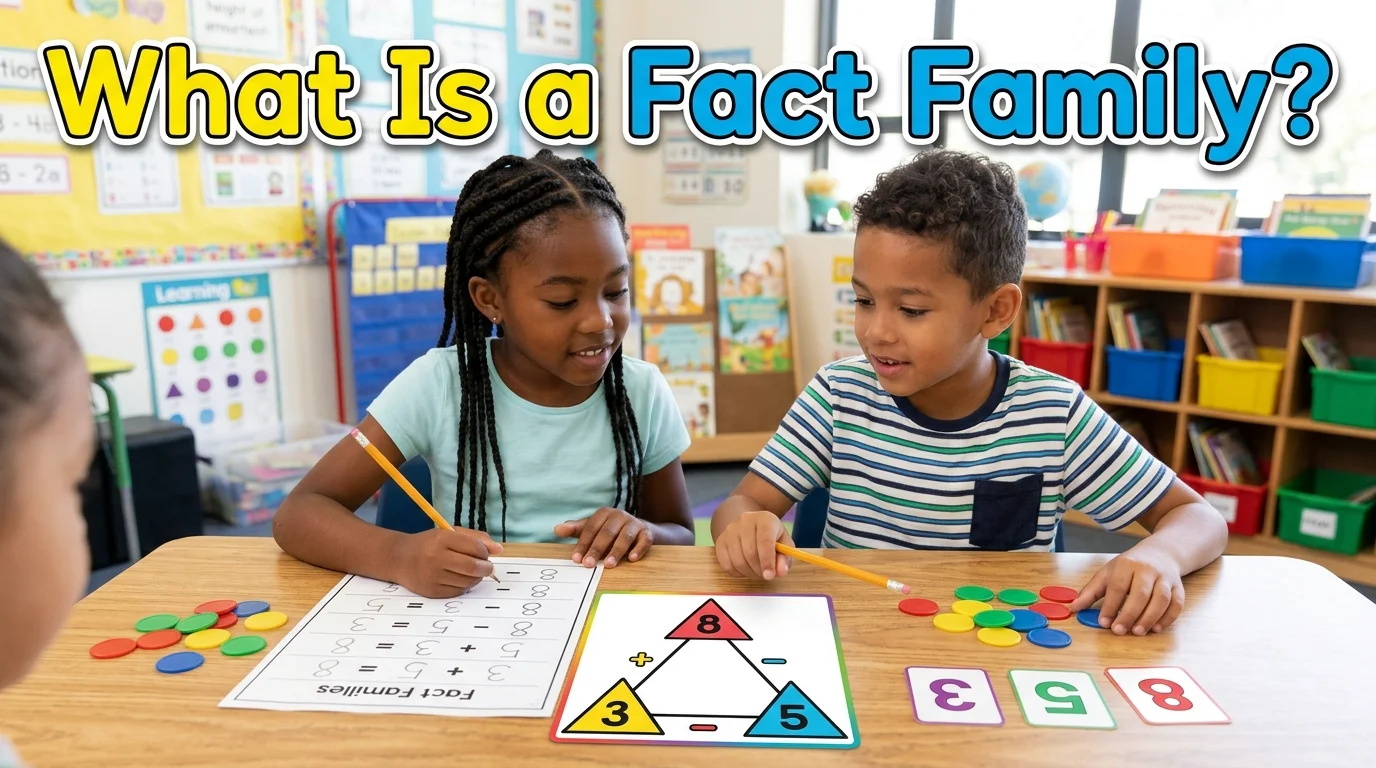
If you are wondering what is a fact family, the idea is simpler than its name sounds. A fact family is a group of related math equations that use the same numbers. These equations help children see how basic math operations connect.
For example, the numbers 3, 4, and 7 belong together because 3 + 4 \= 7. The same numbers can create several related equations. Learning those connections can make addition, subtraction, multiplication, and division easier.
Quick Facts About Fact Families
| Topic | Key information |
|---|---|
| Basic meaning | A set of related equations using the same numbers |
| Common number count | Three numbers |
| Addition and subtraction | Usually two addition facts and two subtraction facts |
| Multiplication and division | Usually two multiplication facts and two division facts |
| Common school level | Addition and subtraction often appear in early elementary math |
| Main benefit | Helps children understand relationships instead of memorizing isolated answers |
| Common visual tool | A triangle or fact-family house |
Direct answer: What is a fact family? It is a group of related math facts using the same three numbers. For 3, 4, and 7, the equations are 3 + 4 \= 7, 4 + 3 \= 7, 7 − 3 \= 4, and 7 − 4 \= 3.
What Is a Fact Family in Math?
A fact family connects several equations built from one group of numbers. In addition and subtraction, two numbers act as parts. The third number represents the whole.
Consider the numbers 5, 6, and 11. Adding the two smaller numbers gives the largest number. Subtracting either smaller number from 11 reveals the other part.
The four related equations are:
* 5 + 6 \= 11. * 6 + 5 \= 11. * 11 − 5 \= 6. * 11 − 6 \= 5.
All four equations describe the same relationship between 5, 6, and 11. Children do not need to treat each equation as unrelated information. They can use one known equation to work out the others.
How Do Addition and Subtraction Families Work?
Addition combines two parts to make a whole. Subtraction starts with the whole and removes one part. This relationship is why addition and subtraction are called inverse operations.
Suppose a child knows that 8 + 2 \= 10. That knowledge can help solve 10 − 8 without starting over. The missing part must be 2 because 8 and 2 combine to make 10.
Here is another example:
| Numbers | Addition facts | Subtraction facts |
|---|---|---|
| 2, 5, 7 | 2 + 5 \= 7; 5 + 2 \= 7 | 7 − 2 \= 5; 7 − 5 \= 2 |
| 4, 6, 10 | 4 + 6 \= 10; 6 + 4 \= 10 | 10 − 4 \= 6; 10 − 6 \= 4 |
| 7, 8, 15 | 7 + 8 \= 15; 8 + 7 \= 15 | 15 − 7 \= 8; 15 − 8 \= 7 |
This structure also introduces an important property of addition. Changing the order of the addends does not change their sum. That is why 4 + 6 and 6 + 4 both equal 10.
Why Do Children Learn Related Math Facts?
Related equations help children build number sense. Instead of memorizing many disconnected answers, they learn how numbers behave together. That understanding can make mental math faster and more flexible.
The method also helps with missing-number problems. A child solving 7 + ___ \= 12 can think about the related subtraction equation. Since 12 − 7 \= 5, the missing number is 5.
This reasoning becomes useful when students face written problems. They must often decide which operation fits a situation. Magazinozo’s guide to math word problem strategies offers more ways to turn written information into equations.
What Is a Fact-Family Triangle?
A fact-family triangle is a visual tool containing three related numbers. The whole usually appears at the top. The two parts appear in the bottom corners.
For the numbers 3, 5, and 8, place 8 at the top. Put 3 and 5 in the lower corners. Students can then use those three positions to create the four equations.
A child can also cover one corner of the triangle. The two visible numbers become clues for finding the missing number. This turns the diagram into a simple practice activity.
Triangles help children focus on the relationship between parts and the whole. They also reduce the temptation to memorize equations without understanding them. U.S.-focused teaching resources commonly use this visual approach in early elementary math.
Can Multiplication and Division Make Families Too?
Yes. The same idea later works with multiplication and division. These operations also have an inverse relationship.
Take the numbers 3, 4, and 12. The multiplication equations show how the factors create the product. The division equations work backward from that product.
The four equations are:
* 3 × 4 \= 12. * 4 × 3 \= 12. * 12 ÷ 3 \= 4. * 12 ÷ 4 \= 3.
This connection can make division less intimidating. A student who knows 6 × 5 \= 30 can use it to solve 30 ÷ 6. The answer is 5 because the same three numbers remain connected.
Addition and subtraction relationships are commonly taught before multiplication and division relationships. Multiplication and division become especially useful as students develop fluency with multiplication facts. Current educational resources often place this progression across the early elementary grades.
What Happens When Two Numbers Are the Same?

Not every set produces four different equations. Sometimes switching the two parts creates the same equation. This happens when both parts have the same value.
Consider 5, 5, and 10. The addition equation is 5 + 5 \= 10. Reversing the two fives does not create a new fact.
The useful equations are:
* 5 + 5 \= 10. * 10 − 5 \= 5.
The same situation can occur with multiplication. For example, 4 × 4 \= 16 does not change when its factors switch positions. Students should understand the relationship rather than force four different equations.
How to Teach the Idea at Home
Parents do not need special materials for practice. Small objects such as coins, blocks, buttons, or cereal pieces can show parts and wholes. Physical objects can make an abstract equation easier to understand.
Start with six objects and split them into groups of two and four. Ask the child how many objects are present altogether. Then ask what remains after removing either group.
You can write the related equations together afterward. Connecting the written symbols to real objects gives each equation meaning. This approach works better than asking children to copy patterns without explanation.
Parents can also make simple number cards. Choose two smaller values, then calculate their total for a third card. Challenge the child to create every valid addition and subtraction equation.
Magazinozo’s broader Education section contains more learning-focused material for students and families. It can be useful when you want additional study topics beyond basic arithmetic.
Common Mistakes Children Make
One common mistake is starting subtraction with a smaller part. For addition and subtraction sets, subtraction begins with the whole. The largest number therefore usually appears first in the subtraction equation.
Another mistake involves mixing unrelated numbers. All equations in the group must use the same three values. Changing one number creates a different relationship.
Children may also memorize the four-equation pattern without understanding it. Ask them to explain which number is the whole and which numbers are parts. Their explanation shows whether they understand the concept.
Finally, students sometimes think addition and subtraction are separate topics. Showing how one operation reverses the other can correct that misunderstanding. The same reasoning later supports multiplication and division.
Simple Practice Examples
Try the following number sets with a child. Ask for the addition equations before moving to subtraction. Then let the child explain why each answer works.
Numbers 4, 7, and 11
* 4 + 7 \= 11. * 7 + 4 \= 11. * 11 − 4 \= 7. * 11 − 7 \= 4.
Numbers 6, 3, and 9
* 6 + 3 \= 9. * 3 + 6 \= 9. * 9 − 6 \= 3. * 9 − 3 \= 6.
Numbers 4, 5, and 20
* 4 × 5 \= 20. * 5 × 4 \= 20. * 20 ÷ 4 \= 5. * 20 ÷ 5 \= 4.
After practicing equations, move into short story problems. This helps children apply number relationships instead of recognizing only worksheet patterns. Real situations also strengthen problem-solving skills.
Frequently Asked Questions
What is a fact family for kids?
A fact family is a group of math equations using the same related numbers. Children use those numbers in different orders or with inverse operations. The goal is to see how one math fact connects with another.
How many facts are usually in one family?
A typical addition and subtraction set contains four equations. It has two addition equations and two subtraction equations. Equal parts can reduce the number of different equations.
What grade do students learn fact families?
Many U.S. students meet addition and subtraction relationships during early elementary school. Similar thinking later connects multiplication with division. Exact pacing can vary by school, curriculum, and state standards.
Why are related facts important?
They help children understand how operations connect. This knowledge can improve mental math and missing-number reasoning. It also reduces dependence on memorizing every equation separately.
Is a number bond the same thing?
The ideas are closely related, but the representations differ. A number bond shows how a whole breaks into parts. Related equations express those same relationships using operation symbols.
Can I use these relationships for division?
Yes. Multiplication and division form another inverse pair. A known multiplication equation can therefore help a student solve the matching division problem.
A Simple Way to Remember the Idea
Think of three numbers that belong together. Identify the parts and the whole before writing any equations. Then use inverse operations to show every valid relationship.
The goal isn’t to memorize a four-line template. Children should understand why each equation works. Once that relationship is clear, harder arithmetic becomes easier to reason through.
For continued learning, explore more math resources and study ideas for families.
