

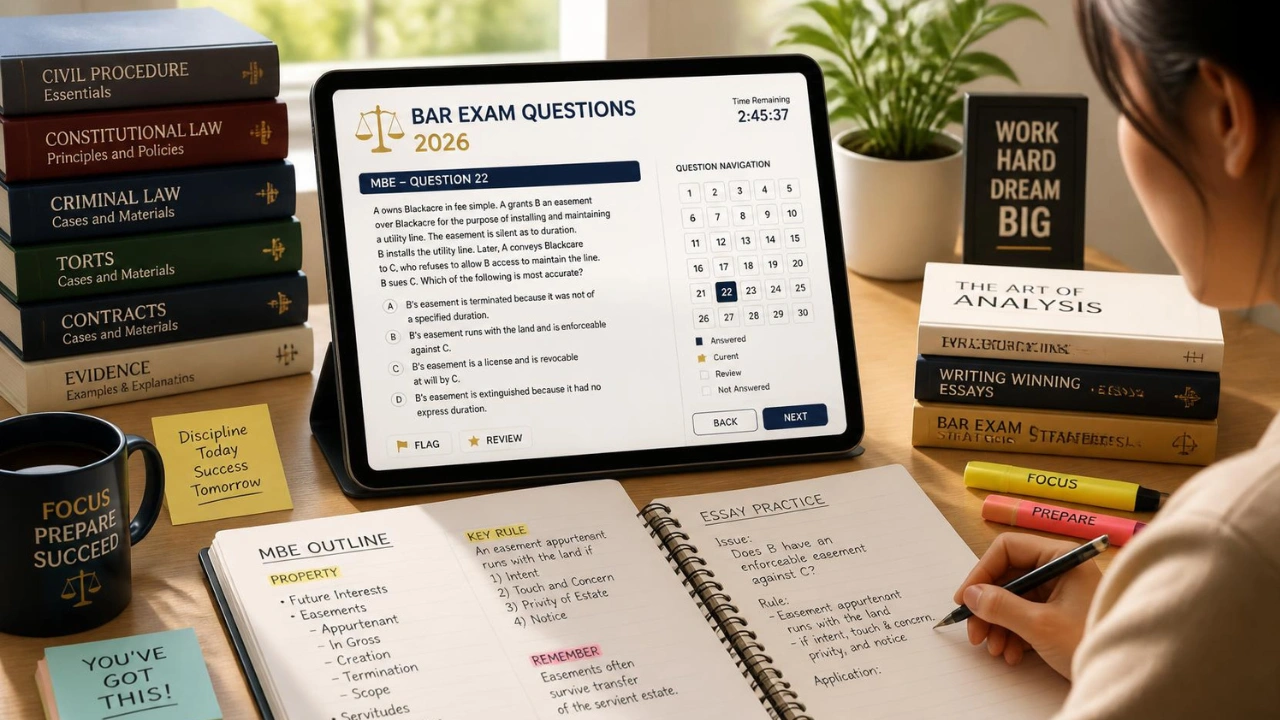
U.S. bar exam questions now depend heavily on your jurisdiction. Legacy UBE jurisdictions use MBE multiple-choice items, MEE essays, and MPT performance tasks. NextGen UBE jurisdictions use standalone multiple-choice items, integrated question sets, and performance tasks. Check your jurisdiction’s 2026 format first, then practice with official or licensed material that matches it.
| What to check | Legacy UBE | NextGen UBE |
| Main formats | MBE, MEE, and MPT | Standalone multiple-choice, integrated question sets, performance tasks |
| Testing schedule | Two days | One and a half days |
| Written work | Essays and performance tasks | Short, medium, and long responses within integrated sets and tasks |
| Best starting point | Official MBE, MEE, and MPT materials | Official NextGen samples and study aids |
Key Takeaways
The U.S. is currently using two major testing formats. Your state or jurisdiction determines which one applies. Start with your jurisdiction’s current rules, use authentic materials when possible, and spend as much time reviewing answers as you spend completing questions.
How Bar Exam Questions Differ in 2026
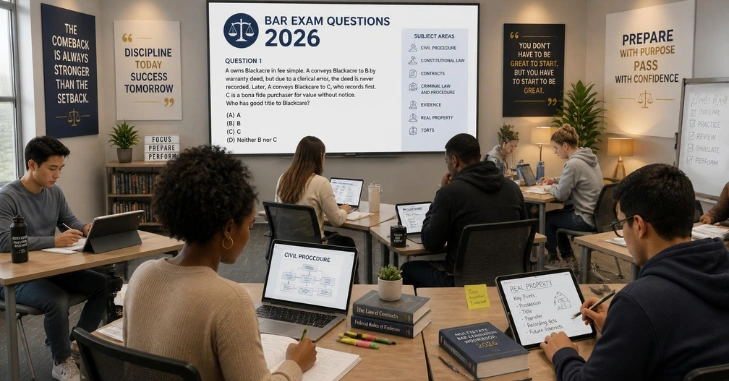
The United States is in a period of transition. The NextGen UBE began its operational rollout in July 2026, while other jurisdictions continue using legacy components. NCBE says the transition will continue through 2028, with adoption dates varying by jurisdiction.
That means a study plan designed for another state may not align with your test. Check the examining authority for the jurisdiction where you intend to sit. Then confirm whether you need legacy UBE materials, NextGen materials, or state-specific content.
Bar Exam Questions Readers who want a broader legal background can also browse Magazinozo’s Law section. Use general legal articles for context while relying on official testing sources for exam specifications.
What the Legacy UBE Tests
The legacy UBE combines three components. The MBE consists of 200 multiple-choice items, completed over two three-hour sessions. Of those 200 items, 175 are scored, and 25 are unidentified pretest items.
The seven MBE subject areas are Civil Procedure, Constitutional Law, Contracts, Criminal Law and Procedure, Evidence, Real Property, and Torts. The scored questions are distributed evenly across those subjects.
The MEE uses six 30-minute essay questions. A notable 2026 change took effect with the July administration. Conflict of Laws, Family Law, Trusts and Estates, and Secured Transactions are no longer tested on the MEE.
The MPT focuses on practical legal work rather than memorizing a rule in isolation. Candidates receive a file and legal materials and must produce a work product within the allotted time.
Contracts remain part of the tested material. For general background on how a real dispute may develop, Magazinozo has an article on breach of contract. Treat it as supplementary reading, not as a substitute for the applicable NCBE outline.
What NextGen Question Types Look Like
NextGen changes both the mix of questions and the skills candidates must demonstrate. It uses standalone multiple-choice items, integrated question sets, and performance tasks.
Standalone questions may provide four to six answer options. Some ask you to choose one answer, while others may require more than one correct selection. Integrated sets pose several questions around a single factual scenario and may include statutes, cases, or other materials.
Performance tasks require candidates to work with a closed set of legal and factual materials. The goal is to assess the skills expected of a newly licensed lawyer, such as analysis, drafting, and the application of supplied legal authority.
NCBE states that standalone multiple-choice work accounts for 49% of the NextGen score. Integrated sets account for 21%, while performance tasks account for 30%. The examination runs across three three-hour sessions over one and a half days.
Two Original Practice Examples
The following examples are original illustrations. They are not official NCBE items and should not be presented as released questions.
Example 1: Multiple Choice
A furniture merchant sends a buyer a signed written offer to sell 100 chairs. The writing states that the offer will remain open for 30 days. The buyer provides no consideration for that promise. Ten days later, the merchant attempts to revoke the offer.
Which answer is strongest?
A. The revocation is effective because the buyer gave no consideration.
B. The revocation is ineffective during the stated period because the merchant gave a signed written assurance.
C. The revocation is effective because the goods have not been delivered.
D. The offer is irrevocable only if the buyer has already paid part of the price.
Answer: B. Under the UCC firm-offer rule, a merchant’s signed written assurance can keep an offer open without separate consideration for the stated period, subject to the rule’s limits.
Example 2: Short Written Response
A property owner knows that a stairboard outside an apartment is loose. The owner neither repairs it nor warns a lawful guest. The guest steps on the board, falls, and suffers an injury.
A strong short response would identify duty, breach, factual and legal causation, and damages. The precise premises-liability rule may depend on the governing jurisdiction.
For more background on negligence concepts, readers can review Magazinozo’s personal injury law explainer before returning to exam-specific outlines.
Where to Find Reliable Practice Material
The strongest starting point is material that matches the real testing program. NCBE provides official study aids for legacy components and separate resources for NextGen preparation. Its current study-aid pages include authentic questions, answer explanations, and sample written responses.
NCBE also publishes free NextGen sample questions showing the major item formats. Those samples are especially useful if your jurisdiction has moved to the new test.
State examining authorities can be useful for written practice. Maryland, for example, publishes past MEE and MPT materials with representative good answers. Texas provides past questions and selected answers along with writing recommendations.
Avoid copying supposedly “real” secure questions from unauthorized sources. NCBE states that protected MBE content may not be reproduced or disclosed without authorization.
For broader study and student-focused material on the site, Magazinozo’s Education archive can provide another internal path for readers.
How to Turn Practice Into Better Performance
Completing hundreds of questions has limited value if you never study your mistakes. A better process connects each missed item to a specific rule, reasoning error, or time-management problem.
- Match the format to your jurisdiction. Don’t spend most of your time on a component you won’t take.
- Begin with accuracy before speed. Work through smaller sets and explain why each option succeeds or fails.
- Keep a mistake log. Record the rule, the fact you missed, and the reason your answer looked attractive.
- Add timed sessions gradually. Once your reasoning is consistent, practice under the time pressure of your actual format.
- Revisit missed concepts. Retry similar problems after several days instead of rereading the same explanation immediately.
Released questions are especially useful because they expose you to the style and reasoning expected by the testing authority. Practice also becomes more valuable when you review detailed explanations and feedback rather than looking only at the answer letter.
Your Next Step
Confirm your jurisdiction’s current format before building a study calendar. Then complete one official or licensed diagnostic set of bar exam questions and review every answer, including the choices you rejected.
Use that first session to identify weak subjects and reasoning patterns. A focused practice plan based on your own errors will usually teach you more than collecting random bar exam questions from across the web.
Frequently Asked Questions
Start with NCBE’s official study aids and sample-question pages. Your state or jurisdiction’s examining authority may also publish past essay questions, performance tasks, selected answers, or other preparation materials.
The legacy MBE contains 200 multiple-choice items. NCBE identifies 175 as scored items and 25 as unscored pretest items, but candidates cannot tell which are unscored.
The biggest change is the active rollout of the NextGen UBE. Some jurisdictions began using it in July 2026, while others continue the legacy format during the transition period.
Your main preparation should match the examination you are registered to take. Check your jurisdiction’s announced administration date before buying courses, question banks, or study aids.
