

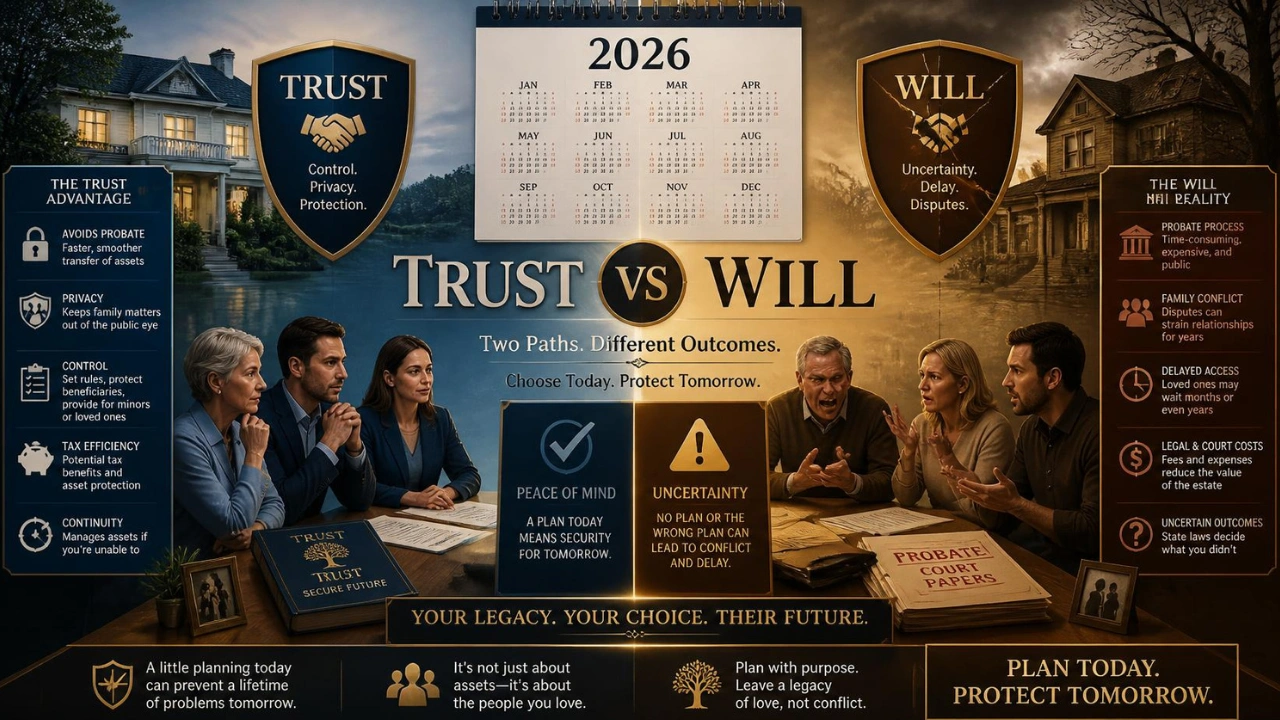
When comparing trust vs. will, the better choice depends on your assets, family, privacy goals, and state probate rules. A simple estate may work well with a properly drafted will. Property owners, blended families, and people seeking greater privacy or incapacity planning may benefit from adding a revocable arrangement. Also worth reading: Bar Exam Questions.
Neither option is automatically better. A will can direct probate assets, name an executor, and nominate guardians for minor children. A properly funded revocable living trust can keep covered property out of probate, preserve privacy, and support asset management during incapacity. Many estate plans use both.
Trust vs Will at a Glance
The biggest differences involve probate, privacy, timing, guardianship, and ongoing management. State law can affect how much those differences matter, because probate procedures and costs vary widely from one state to the next.
| Feature | Will | Revocable living trust |
| Takes effect | At death | During your lifetime, once created and funded |
| Probate | Covered estate assets generally pass through probate. | Properly funded assets generally avoid probate. |
| Privacy | Probate filings may become public. | Covered assets usually remain outside public probate files. |
| Minor children | Can nominate a guardian | Does not replace the guardianship role of a will |
| Incapacity planning | Does not operate during incapacity | A successor trustee may manage covered assets. |
| Setup | Usually simpler | Requires more setup and asset transfers |
| Ongoing work | Usually limited | New or changed assets may require updates. |
| Multi-state real estate | May create additional probate proceedings | Can simplify the transfer of properly titled property |
What a Will Does
A last will records how you want certain property handled after your death. It can name beneficiaries and an executor. Parents can also use it to nominate guardians for minor children.
A will only operates after death. Assets controlled by it usually pass through probate, where a court supervises the administration of the estate. Probate rules, timelines, and simplified-estate procedures depend on state law. For more general legal explainers, readers can browse Magazinezine’s Law section.
Pros of a will
- Simple starting point: It is often easier to create and maintain.
- Guardianship: Parents can record whom they want the court to consider as a guardian for their minor children.
- Executor choice: You can select the person who should administer your estate.
- Broad safety net: It can address property left in your individual estate at death.
Cons of a will
- Assets governed by it may require probate.
- Probate filings may become public records.
- It does not manage property if you become incapacitated.
- Court administration can add time and expense after death.
These drawbacks do not make a will a poor choice. For a straightforward estate, simplicity may outweigh the benefits of a more complex structure.
What a Revocable Living Trust Does
A revocable living trust is created during your lifetime. You transfer selected property into it and normally retain control while you can manage your affairs.
Funding matters as much as signing the document. A living trust controls only property that has been properly transferred or otherwise directed to it. Assets left outside it may still require another transfer method or probate.
Pros of a living trust
- Properly titled assets can avoid probate.
- Trust-owned property can remain more private.
- A successor trustee can manage covered assets during incapacity.
- Instructions can control when beneficiaries receive property.
- It may simplify administration when you own real estate in several states.
Cons of a living trust
Creating one usually takes more work than preparing a basic will. The trust must be funded, and your asset titles may need to be updated as your finances change.
It also does not eliminate the need for every other estate-planning document. Parents still need appropriate guardianship provisions, and property outside the arrangement needs a backup plan.
How to Choose: Trust vs. Will

Your decision becomes easier when you match the documents to the problems you need to solve.
| Your situation or goal | Practical starting point |
| Simple finances and few probate assets | A will may cover the essentials. |
| Minor children | Keep a will for guardian nominations. |
| Strong concern about probate or privacy | Consider adding a funded revocable plan. |
| Property in several states | Discuss a revocable plan with an estate attorney. |
| Incapacity planning is a priority. | Consider a revocable plan plus other incapacity documents. |
| Blended family or staged inheritances | Get individualized legal advice. |
| Most wealth has named beneficiaries. | Review beneficiary forms before adding complexity. |
Unmarried couples should pay special attention to beneficiary choices and state inheritance rules. Magazine’s guide to domestic partner rights and benefits provides useful background on legal differences affecting unmarried households.
Three Details Many Comparisons Miss
1. Beneficiary forms can change the result
Your estate documents are not the only instructions that matter. Retirement accounts, life insurance policies, and other financial accounts may transfer through beneficiary designations rather than through a will.
That means an old beneficiary form can undermine a newer estate plan. Review account designations after a marriage, divorce, birth, death, or other major life change.
2. A living will is something different.
A living will concerns medical treatment if you cannot communicate your wishes. It is an advance healthcare document, not a property-transfer trust. Confusing the two can leave gaps in both financial and healthcare planning.
3. A revocable living trust is not automatically a tax-saving tool.
Do not assume that probate avoidance equals estate tax avoidance. Assets in a revocable living trust generally remain part of the creator’s estate for tax purposes. More specialized tax planning may require different tools and professional advice.
Verdict: Which One Should You Choose?
The trust vs. will decision is often less about choosing a winner and more about deciding whether a will alone covers your needs.
Start with a will when your finances are straightforward and you need basic instructions or executor or guardian nominations. Consider adding a funded revocable plan when probate avoidance, privacy, incapacity management, multiple properties, or controlled distributions matter more.
For many households, the documents complement each other. People who create a revocable arrangement often still keep a will to cover functions and assets outside that arrangement.
Before signing anything, list your property, account beneficiaries, family needs, and the states where you own real estate. Then review those facts with an estate-planning attorney licensed in your state. You can also browse Magazinezine’s Finance section for related financial-planning topics.
Conclusion
Choosing between a trust vs. will is not simply about deciding which estate-planning document is better. The right choice depends on your family situation, assets, financial goals, privacy concerns, and the probate laws in your state. For some households, a straightforward will may provide everything needed to name an executor, distribute probate assets, and nominate guardians for minor children. For others, a properly funded revocable living trust can provide additional benefits, particularly when avoiding probate, planning for incapacity, maintaining privacy, or managing property in multiple states is important.
Frequently Asked Questions
No. A will and a revocable estate arrangement can perform different functions. Many plans combine them, especially when someone wants probate planning while retaining guardian nominations and a backup for assets not transferred during life.
Property properly transferred into the arrangement can generally pass outside probate. Assets still held individually without another transfer mechanism may remain subject to probate.
Often, yes. A will can address assets left outside the funded arrangement and can nominate guardians for minor children. Some estate plans use a pour-over will for property that was not transferred earlier.
A will is the standard estate-planning document used to nominate a preferred guardian for minor children. The court applies applicable state law when making the formal appointment.
A basic will is usually less expensive and easier to set up. A revocable plan often costs more upfront and requires asset transfers and ongoing maintenance. Probate costs also vary, so the cheapest option during life may not produce the lowest administration costs later.
